The Pre-Pottery Neolithic Site of Atlit-Yam
Submerged Prehistoric Settlements
Several Neolithic settlements dating from the 9th to the 7th millennium BP (uncalibrated C14) have been exposed on the seabed along the Carmel coast. The sites include a Pre-Pottery Neolithic C (PPNC) settlement called Atlit-Yam, and five Pottery-Neolithic (PN) settlements belonging to the Wadi Rabah culture.
Atlit-Yam
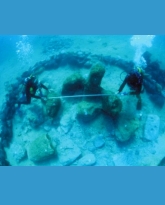
Megalithic structure - after excavation
The site of Atlit-Yam is situated some 200-400 m offshore, at a depth of 8-12 m and extends over an area of ca. 40000 m2. Radiocarbon dates for the site gave a range of 8180-7550 years BP (uncalibrated). The architectural finds consist of stone-built water-wells, foundations of rectangular structures, series of long unconnected walls, round installations, ritual installations and stone-paved areas. In addition, 65 human skeletons were discovered in both primary and secondary burials. In at least four of the male individuals, an inner ear pathology - auditory exostosis - caused by diving in cold water, was observed.
Faunal remains consisted of bones of wild and domesticated animals, including domesticated sheep/goat, pig and dog and cattle on the verge of domestication, as well as numerous remains of marine fish. The fish remains included more than 6000 bones, most of them belonged to Balistes carolinesis, (the grey trigger fish), and a few to Serranidae, Sparidae, Sciaenidae, Mugillidae and other fish families. Artifacts made of stone, bone, wood and flint were also recovered, as well as large quantities of botanical remains, including seeds of domesticated wheat, barley, lentil and flax. Some of the artifacts and plant remains may be associated with fishing. The archaeological material indicates that the economy of the site was complex and was based on the combined utilization of terrestrial and marine resources involving plant cultivation, livestock husbandry, hunting, gathering and fishing. The Atlit-Yam site provides the earliest known evidence for an agro-pastoral-marine subsistence system on the Levantine coast.
Megalithic Installations

Artist's Reconstruction of Megalithic Structure
A ritual installation of megaliths was found at the Atlit-Yam site. It consists of seven stones (1-2.1 m long), six of which are still standing upright, forming a circle (diameter ca. 2.5 m) open to the northwest. The bases of the standing stones are covered with gray travertine attesting to the presence of fresh water in the past. Close to the standing stones to the west, a few flat stone slabs (0.7-1.2 m long) were found lying horizontally. On some of them were hewn shallow cup-marks. It is suggested that these features formed part of a ritual structure, perhaps associated with a fresh-water spring that may have existed at the site. Another installation consists of three oval stones (1.6-1.8 m), two of which are circumscribed by grooves forming schematic anthropomorphic figures.
Stone-built well from Atlit-Yam
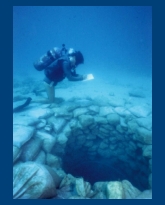
Stone-Built Water Well, Atlit-Yam
The well was excavated down to its bottom (5.5 m below sea bottom, 15.5 m below sea-level); the sediments fill contained animal bones, stone, flint, wood and bone artifacts, in addition to charcoal and waterlogged botanical remains. The finds indicate that in its final stage, it ceased to function as a water-well and was used instead as a desposal pit. The change in function was probably related to salinization of the water due to a rise in sea-level. The wells from Atlit-Yam had probably been dug and constructed in the earliest stages of occupation (the end of the 9th millennium BP) and were essential for the maintenance of a permanent settlement in the area.