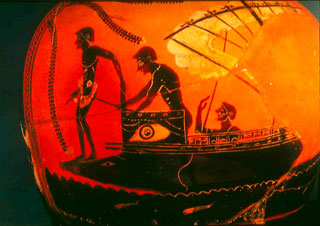
Courtesy of The British Museum
A marble discus, which dates to the fifth-fourth century BCE, was found by David Shalom, a lifeguard, while diving in the antiquities site of Yavne-Yam, next to Palmahim beach. The lifeguard gave the discus to the Israel Antiquities Authority.
The white discus, which is flat on one side and convex on the other, measures 20 centimeters in diameter. In the middle of the discus are a perforation and the remains of two circles that are painted around the center of it. This object has been identified as representing the pupil of an eye that adorned the bow of an ancient warship or cargo ship. Its Greek name is ophtalmoi and a lead coupling or bronze nail that was driven through the hole in the center of the discus was used to attach the object to the hull of the ship.
According to Kobi Sharvit, the director of the Marine Unit of the Israel Antiquities Authority, “We know from drawings on pottery vessels, pithoi and ancient coins, as well as from historic sources of the fifth century BCE that this model was very common on the bows of ships and was used to protect them from the evil eye and envy, and was meant as a navigation aid and to act as a pair of eyes which looked ahead and warned of danger. This decoration is also prevalent today on modern boats in Portugal, Malta, Greece and in the Far East.
Even though this item was common and one would expect that many such objects would be found, it is actually quite rare: to date we know of only four other such ancient artifacts that were discovered in the Mediterranean Sea. Two were recovered from ancient cargo shipwrecks (440-425 BCE) that were found along the western coast of Turkey between the islands of Samos and Chios at the site of Tektas Burnu and two items were recovered from the Mediterranean Sea off the coast of Israel: one from the Carmel coast and the other which was just discovered at Yavne-Yam.
The port city of Yavne-Yam was first settled in the Middle Bronze Age and was inhabited until the Middle Ages. Near the tell is a natural anchorage that is protected by kurkar reefs in the west and two capes located to the south and north.
During the course of archaeological surveys that have been performed there by the Marine Unit of the Israel Antiquities Authority since the 1980’s artifacts were found that originated in shipwrecks, including anchors of various sizes and weights with one to three holes in them, fishing equipment, lead connectors and stone plumbs that belong to stone anchors. Other objects that were found which were used onboard boats include an oven for cooking that is made of lead, grindstones, stone bowls, fishing gear (bronze hooks, lead weights for fishing nets and lead plumbs for measuring the depth of the seabed), as well as storage jars, amphorae, bowls and cooking pots that date to the Late Bronze Age, Persian, Hellenistic, Roman and Byzantine periods. All of these bear witness to the extensive commercial activity that transpired there.
Most of the pottery vessels are of types that were manufactured in the Land of Israel or in the Eastern Mediterranean; however, some were imported from more distant lands along the Mediterranean Sea. A concentration of artifacts was discovered at the site which date to the Bronze Age and include dozens of gold objects (earrings, beads, pieces of jewelry and waste from the jewelry industry) and a hematite seal of Syrian provenance. The concentration was located scattered in an area where twenty hematite seals, bronze arrowheads, axes and two small statues of the god Ba’al were found in the past. The archaeological finds indicate that the anchorage was used continuously from the Late Bronze Age until Middle Ages.
Additional Articles ...