In the archaeological excavations the Israel Antiquities Authority is conducting at the Givati car park in the City of David, in the Walls around Jerusalem National Park:
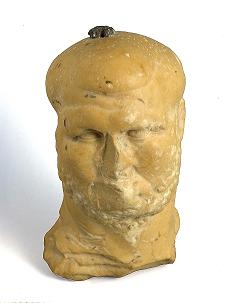
Picture of the figurine - Photographic credit: Clara Amit, Israel Antiquities Authority
An 1,800 Year Old Marble Figurine in the Image of a Bearded Man, probably that of a Roman Boxer, was Discovered
The figurine was used as a suspended weight together with a balance scale. This is probably the only find of its kind from excavations in the country.
A figurine (bust) made of marble depicting a miniature image of a bearded man’s head was discovered in the excavations that the Israel Antiquities Authority is conducting in the area of the Givati car park in the City of David, in the Walls around Jerusalem National Park.
According to Dr. Doron Ben-Ami and Yana Tchekhanovets, directors of the excavation at the site on behalf of the Israel Antiquities Authority, “The high level of finish on the figurine is extraordinary, while meticulously adhering to the tiniest of details. Its short curly beard, as well as the position of its head which is slightly inclined to the right, are indicative of an obviously Greek influence and show that it should be dated to the time of the emperor Hadrian or shortly thereafter (second-third centuries CE). This is one of the periods when the art of Roman sculpture reached its zenith. The pale yellow shade of the marble alludes to the eastern origin of the raw material from which the image was carved, probably from Asia Minor, although this matter still needs to be checked”.
The stylistic motifs that are manifested in the image, such as its short hair style, the prominent lobes and curves of the ears, as well as the almond-shaped eyes suggest that the object most likely portrays an athlete, probably a boxer. Boxing was one of the most popular fields of heavy athletics in Roman culture and more than once Roman authors mention the demand by the Roman public in general, and the elite in particular, for boxing matches. Besides the prestige and the substantial amounts of money the victors of boxing competitions won, they were also afforded the support of the emperor himself, as in the famous case of Melancomas who was Titus’ favorite boxer.
Dr. Ben-Ami and Tchekhanovets elucidate, “To the best of our knowledge, to date no similar artifact made of marble (or any other kind of stone) bearing the same image that was just found has been discovered in excavations elsewhere in the country; it seems that what we have here is a unique find. A few similar artifacts that were made of cast bronze were discovered at different sites in the country and they have been found in large numbers in different places throughout the Roman Empire where the overwhelming majority of them date to the third century CE (the Roman period). The bronze portrayal of a boxer that is currently on display in the Berlin State Museum (“The Boxer”) is a nearly perfect parallel of the image from the City of David”.
According to the researchers the two tiny holes that were drilled in its nape and which contained the remains of metal that was inserted in them indicate that this is a suspended weight that was used with hanging scales that are characteristic of the Roman period. Miniature bronze images of athletes, philosophers, satyrs etc were among the most popular of the suspended weights that were used in the regions that were under the control of the Roman Empire – from Pompeii to Sepphoris.
How did the Roman marble image get to the City of David?
We can assume that this marble weight belonged to a family of merchants who originally came from somewhere in the eastern part of the Roman Empire. Being a precious object the weight was passed down from generation to generation in the family until sometime in the fourth-fifth century CE when an unidentified merchant was so unfortunate as to stay in the public building (a hostel??) which is currently being uncovered in the Givati car park in the City of David. A very severe tremor that struck the building resulted in its complete destruction. While exposing the building the marble image was discovered amongst its ruins which constitute silent testimony of the drama that occurred in this impressive structure prior to its collapse.
Not long ago one of the largest and most impressive coin hoards ever found in Jerusalem was discovered at this site. It consists of 264 gold coins and was found at about the same time as a gold earring, inlaid with expensive pearls and remarkably well preserved, was also uncovered at the site.
For additional details, kindly contact:
Meyrav Shay, Acting Spokesperson of the Israel Antiquities Authority: 972-52-4284408, meyrav@israntique.org.il
Additional Articles ...